
Illustrative artwork — not a photograph of the client’s premises.
Project overview
An independent consulting engagement supporting an online retail operation spanning grocery, general retail and jewellery. The work centred on connecting stock records, sales channels, warehouse activity and staff routines so day-to-day operations became easier to monitor and manage.
The business challenge
The business needed better visibility from inbound goods to dispatched orders. Inventory information, marketplace activity and warehouse routines had to stay aligned; inconsistent checks and fragmented workflows could create errors, unnecessary rework and delays.
My role & scope
Independent consultant supporting the operating team on inventory controls, fulfilment processes, data visibility and staff adoption. Implementation was collaborative; the reported results reflect the wider team and business, not the work of one person in isolation.
How the work was approached
01 / Understand the flow
Reviewed how goods moved from suppliers through receiving, storage, picking, packing and customer dispatch; identified points where records or responsibilities could become disconnected.
02 / Improve stock controls
Supported barcode-based SKU identification, structured stock checks and clearer reporting to compare warehouse records with the operational system.
03 / Connect sales and fulfilment
Worked across Shopify, Amazon and eBay-related workflows to improve order visibility, status tracking and coordination between platforms and fulfilment activity.
04 / Strengthen daily execution
Helped standardise routines, staff coaching and dashboards to make exceptions easier to identify and recurring work more consistent.
05 / Support replenishment
Contributed to demand-forecasting and stock-replenishment processes so purchasing discussions could better reflect actual inventory movement.
Workstreams & practical outputs
- Process mapping across procurement, stock intake and dispatch
- SKU-level stock controls and stock-check routines
- Operational dashboard and reporting improvements
- Staff coaching and practical process guidance
- Inputs to demand forecasting and replenishment decisions
Outcomes & highlights
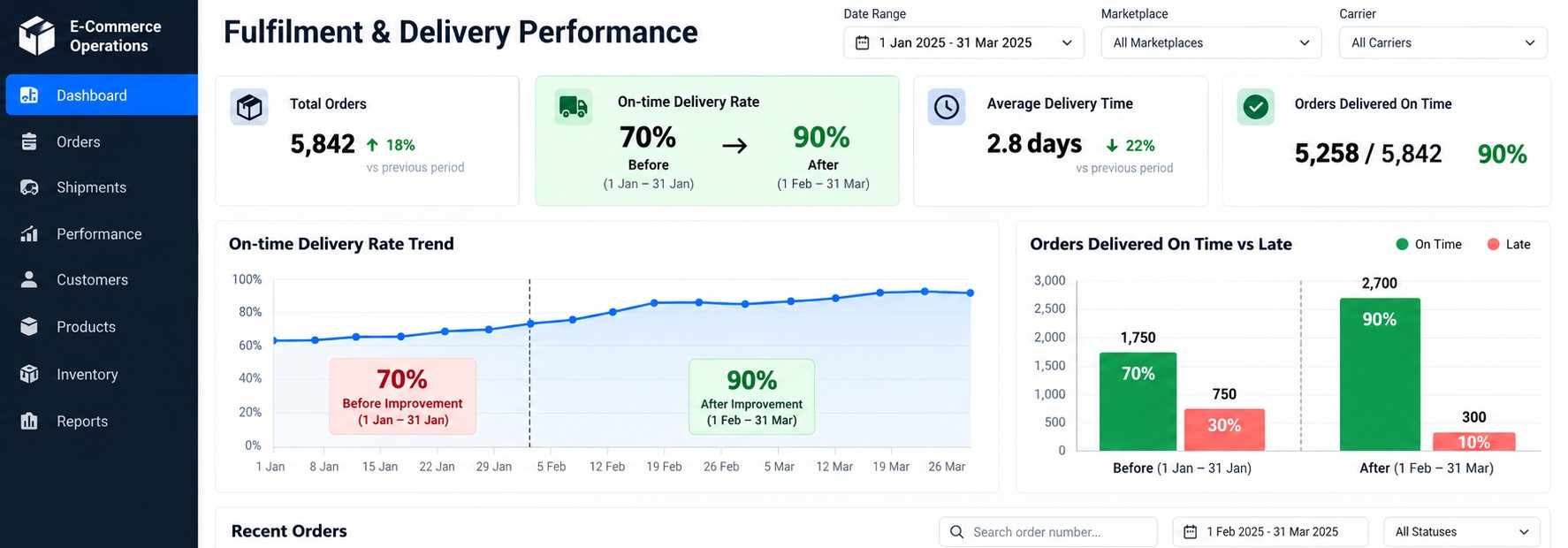
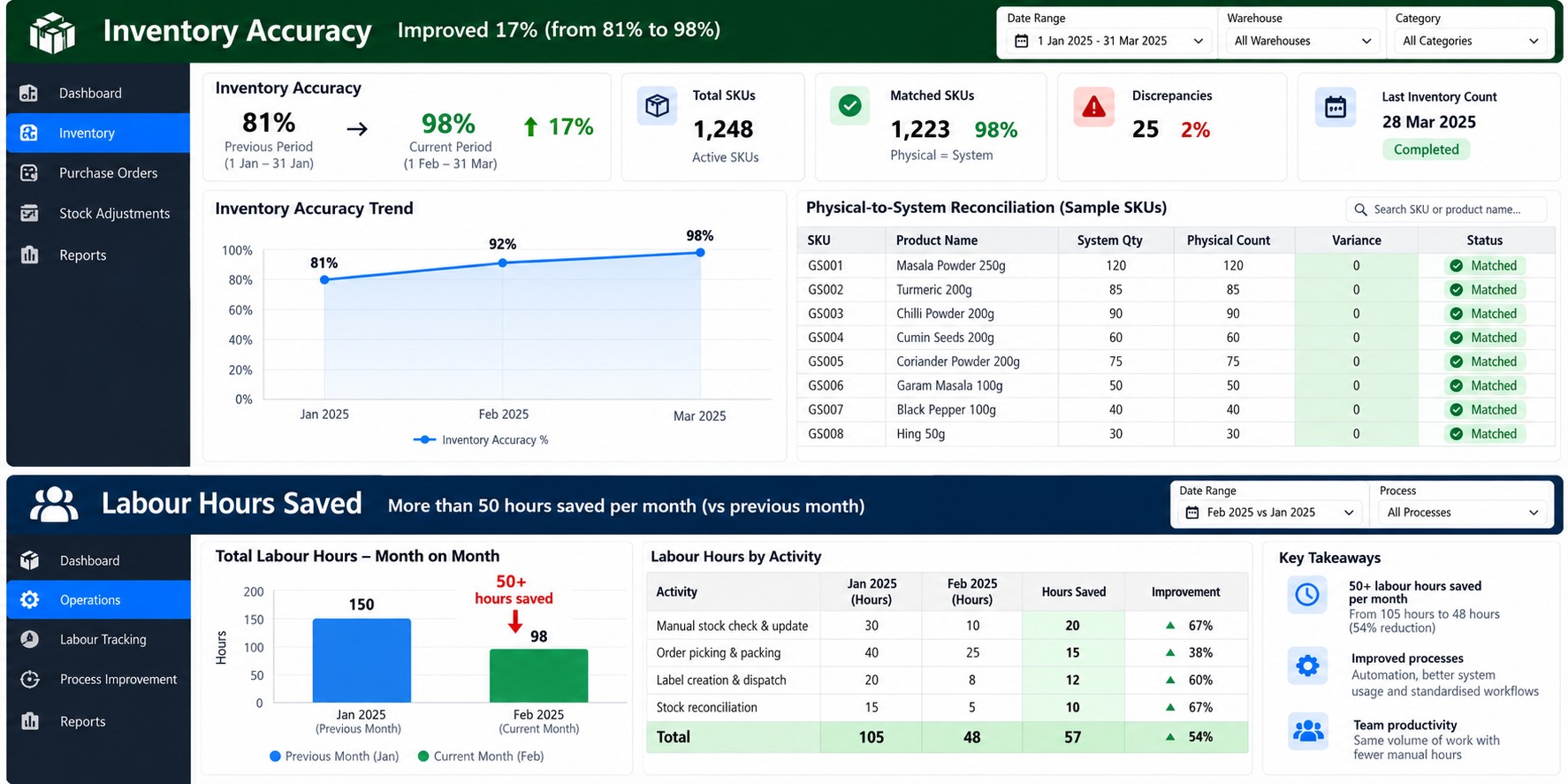
Client-reported movement from 70% to 90% on-time delivery represents a 20 percentage-point change; inventory accuracy from 81% to 98% represents a 17 percentage-point change. The business also reported 50 labour hours saved weekly (client-reported) and 98.3% forecast accuracy for the final four months. These measures come from client/project reporting with differing source comparison periods and labour baselines, so they are not presented as independently verified causal effects.
Supporting dashboard evidence
Selected cropped performance screenshots are included for context. They are records from the project, not AI-generated visuals.
What this project demonstrates
The biggest operating gains often come from getting people, process and system records to agree. A dashboard becomes useful only when receiving, picking and replenishment decisions are backed by consistent daily routines.
Discuss a similar business challenge
Explore how your operational priorities might be approached with practical, project-specific support.
Book a free 15-minute call ↗WhatsApp ↗FINANCIAL-IMPACT SCENARIO · FOR REVIEW
How labour time can translate into capacity value
Using a proposed baseline of 50 hours saved per week × 52 weeks = 2,600 hours of annual staff capacity released. At an assumed £15 hourly rate, this represents an illustrative labour-capacity value of £39,000 per year. This is not necessarily a reduction in payroll costs or independently confirmed financial savings. The weekly baseline and yearly consistency should be checked against client records.
Separately, estimates of £500,000 annual overstock exposure and £2 million additional revenue remain unverified and unattributed; they should not be treated as demonstrated outcomes without source records and agreement on how they were calculated.